[Revelation 21]
All of us know the emotions of change. There is always a double-sided feeling of a divided soul. Even when the change is good, flowing from our good decisions, some elements of the old haunt us and might even come to bite our heels.
Soul changes are the hardest, getting rid of bad habits, old wounds, roots of bitterness fed by the hurt and offence we suffer because of other people’s sin. With all life’s challenges and strife our heart might look like an overgrown, untamed garden with some beautiful flowers and shrubs (caring and loving nature) struggling to grow beneath the thorn bushes and briers of resentment and anger.
I truly rejoice in the promise of the new in the Word of God. Not now and then – daily! God does new things, forgives continually and bring us up to the new heaven and the new earth whenever we ask and set our life focus on His realm. The invitation stands for all eternity.
“Come now, and let us reason together,” says the Lord.
Though your sins are like scarlet, they shall be as white as snow;
Though they are red like crimson, they shall be like wool.
If you are willing and obedient, you shall eat the best of the land; (Isaiah 1:18,19)
Through the Lord’s mercies we are not consumed, because His compassions fail not. They are new every morning. Great is Your faithfulness. (Lamentation 3:22,23)
Chapter 21 of Revelation leads us into the ultimate “new” that God has for us as much as we could grasp with the description in earthly words and concepts.
The doom of the wicked is described in contrast to the “bliss of the blessed.” It is the dream of true new beginnings, so beautifully sung by Isaiah (65:17). When God creates new, the former things are not even remembered.
“For behold, I create new heavens and a new earth; and the former shall not be remembered or come to mind.
Let us rejoice in the caption of this chapter – All Things Made New. We learn about the Church imperfect and the Church perfected. Chapters 1-3 focus on the weaknesses of the churches, chapters 21 -22:5 focus on the perfected state through all eternity.
Then I saw “a new heaven and a new earth,” for the first heaven and the first earth had passed away, and there was no longer any sea. 2 I saw the Holy City, the new Jerusalem, coming down out of heaven from God, prepared as a bride beautifully dressed for her husband. 3 And I heard a loud voice from the throne saying, “Look! God’s dwelling place is now among the people, and he will dwell with them. They will be his people, and God himself will be with them and be their God.4 ‘He will wipe every tear from their eyes. There will be no more death’ or mourning or crying or pain, for the old order of things has passed away.”
5 He who was seated on the throne said, “I am making everything new!” Then he said, “Write this down, for these words are trustworthy and true.”
6 He said to me: “It is done. I am the Alpha and the Omega, the Beginning and the End. To the thirsty I will give water without cost from the spring of the water of life. 7 Those who are victorious will inherit all this, and I will be their God and they will be my children. 8 But the cowardly, the unbelieving, the vile, the murderers, the sexually immoral, those who practice magic arts, the idolaters and all liars—they will be consigned to the fiery lake of burning sulfur. This is the second death.”
The reason John sees a new heaven and a new earth is because the old has passed away. Kainos-new thus new in quality or essence rather than time.
This is all about the transformation of and existing creation instead of the Genesis story of a creation out of nothing (ex nihilo). It connects the new heaven and earth to the Resurrection of Jesus. (Isaiah 65:17-18) Paul addresses it in 2 Corinthians 5:14-17; Colossians 1:15-18 and Ephesians 1:20. In Romans 8:18-23 Paul links the restoration of the corrupted creation to the resurrection of the Children of God.
Christ established the new Jerusalem as He is described as the beginning of God’s creation. (3:14) We are to become new creations. (2 Corinthians 5:17)
The promise of no more sea was a welcome relief to the ancient world. Their attitude towards the sea was well established from mythological roots. The sea was the enemy, the dwelling place of chaos. Sea faring was dangerous and clothed in mystery. In the earliest times of sea travel they hugged the coast with no compass. Sea storms were fierce and scary, especially when darkness blotted out the stars and made navigation impossible. (Acts 28)
The sea was:
- The origin of cosmic evil (4:6;13:1;15:2;16:3)
- The unbelieving nations causing trouble (13;2; 17:1-2,6; Isaiah 57:20)
- The place of the dead (20:13)
- Main area for idolatrous trade (18:11-19)
- Literal body of water part of the old creation (5:13;7:1-3; 8:8-9;10:2,5-6; 14:7)
The Red Sea – symbolic of crisis and captivity – will be no more, passed away with the material elements of the old world order.
The New Jerusalem (21:2) has its roots in Greek philosophy.
One of the great contributions to the world’s philosophical thought was Plato’s doctrine of ideas or forms. He taught that in the invisible world there existed the perfect form or idea of everything upon earth, and that all things on earth were imperfect copies of the heavenly realities. If that were so, there is a heavenly Jerusalem of which the earthly Jerusalem is an imperfect copy.
That is what Paul is thinking of when he speaks of the Jerusalem that is above (Galatians 4:26), and also what is in the mind of the writer to the Hebrews when he speaks of the heavenly Jerusalem (Hebrews 12:22).
This idea of preexisting forms may seem strange, but at the back of it is the great truth that the ideal actually exists. It further means that God is the source of all ideals. To think about the superlative, the supreme, is a challenge, which, even if it is not worked out in this world, would be fully effectuated in the world to come.
The New Jerusalem in the era after Christ, is the Church. Jewish thought provided full restoration, supremacy and rule for the Jewish people. This was echoed by the prophets and always held as the physical restoration of Jerusalem.
For us, the Church is the only possible interpretation. The true Church is the perfect “city” providing for its inhabitants. The Bride is prepared for Jesus. (21:2). The souls of men are the precious stones (Malachi 3). The streets of gold are the gifts of the Holy Spirit guiding our walk on earth in Jesus. We walk upon the royal paths when we are saved. Everything precious in our lifetime is to be found in Jesus. God provides the light; there is no need of the sun. Everything we know to be natural is replaced by the perfection of God’s realm.
To the church of Philadelphia it is made clear that the Church is the continuation of true Israel because Jews and Gentiles will be included in the new Jerusalem. The names of the apostles are on the foundations.
A loud voice – authority in the pronouncement that God’s dwelling place is with his people. The Tabernacle was a temporary structure in the desert to be moved whenever the people moved. It reflects the prophetic promise of Ezekiel 43:7 – in the days of the new Temple God will tabernacle among the sons of Israel forever. Paul alludes to the Tabernacle in 2 Corinthians 6:16, quoting Leviticus 26:12.
And what agreement has the temple of God with idols? For you are the temple of the living God. As God has said:
“I will dwell in them And walk among them. I will be their God,
And they shall be My people.”
Zechariah 2:10-11 foresees the ethnic expansion of the people of God and the boundaries of Israel. All nations are to be blessed through the seed of Abraham. (Genesis 12:1-3; 17:2-8; 26:24; Galatians 3:16 confirmed by Ezekiel 47:22-23) Jesus is the true seed of Abraham and our birth in Him ties us to the true Israel.
Only Jews were allowed in the old Tabernacle – through the Blood of Jesus, Jew and Gentile alike can enter into the Holy of Holies – the first indication that there is no Temple in the New Jerusalem.
The loud voice announces the Tabernacle, the dwelling place of God amongst men. The word used is skene, which means tent. The Tabernacle in the desert was a movable structure, tent-like. It is a temporary dwelling and only a foretaste of the glory to come. God made his dwelling with people.
Here on earth, we experience heaven in the constant awareness of the Presence of God.
The Greek word skene and the Hebrew word schecinah became closely related in early Christian thought because of the connection in sound. Skene came to mean dwell with God and schecinah came to mean God dwelling with men. Shechinah was associated with a luminous cloud, which came and went. In Solomon’s Temple (1 Kings 8:10-11) the shechinahglory filled the house. The priests could not stand in the glorious Presence of God. (2 Corinthians 5:13-14)
[This concept resonated through the Old Testament: Leviticus 26:11-12, Jeremiah 31:33 and 32:39 – 41, Ezekiel 37:27, Song of Songs 6:3]
We enjoy unbroken fellowship with God as He wipes away the tears (21:3,4 and Isaiah 25:8). His presence resolves the sorrow. (Ezekiel 40:1-48:35) First things have passed away and God is doing something new. (Isaiah 43:18-19)
No death – after the Resurrection of Jesus physical death is just a portal to the unseen. Wipe away the tears – the tears still exist as we are still part of the broken world. Mourning, crying and pain – passed away in the old dispensation – within the brokenness there is no mourning (the very elaborate and showy mourning and tears of false sadness that accompanied death – cf the mourners for Jairus’ daughter that Jesus rebuked).
John used all the visions of the perfect city to invoke the picture of the realization of all dreams ever. In the light of the recent destruction of the earthly Jerusalem (70AD) he speaks in faith to revive and encourage.
The New Jerusalem, the Church, is eternal and precious. It can never be destroyed. Destruction is of the earthly. We lift up your eyes and see the perfect. Our eyes should be anointed to “see” clearly and truly into the unseen, by the power of the Holy Spirit. This is our challenge today and every day. To truly see Him in faith on His throne within the pain and strife of this life, is kingdom living.
And Moses said to the people, “Do not be afraid. Stand still, and see the salvation of the Lord, which He will accomplish for you today. (Exodus 14:13)
Moses challenges the people to see the opposite of their fear. Just like them we face “our” Egyptians every day. We have to live in the evil plans of God’s adversary, satan and face all the problems, crisis, and panic that come with his territory. The only solution is our fellowship with God (21:3-4).
All the benefits of heaven reverberate through Isaiah (25:8, 35:10, 65:19). There will be no weeping, no sorrow, and all the tears wiped away. The promise is repeated and confirmed in Matthew 5:4 and Philippians 3:10.
Blessed are those who mourn, for they shall be comforted.
In Christ all things are new (21:5-6). A child of God is a new creation (2 Corinthians 5:17). New things are promised in Isaiah 43:18-19.
“Do not remember the former things,
Nor consider the things of old.
Behold, I will do a new thing,
Now it shall spring forth;
Shall you not know it?
I will even make a road in the wilderness
And rivers in the desert.
Write these words – faithful and true. Christ is described as faithful and true. (3:14)
John is commanded to write it down. It reminds us of a contract, true and trustworthy. We can go back to check and hold the parties responsible to fulfill the articles of the agreement. These are faithful words, so scarce these days.
All is complete within Christ. There is no other God. (Isaiah 44:6)
John hears the Greek word geonan. (21:6) It is done – all the prophetic promises are fulfilled. The new creation was set in motion with the Resurrection.
Alpha and Omega – He is the Beginning, arche meaning the source of all things and the end, telos meaning more than the end, the goal, the ultimate of all things. He is Lord over all history.
For of Him and through Him and to Him are all things, to whom be glory forever. Amen.(Romans 11:36)
…one God and Father of all, who is above all, and through all, and in you all. (Ephesians 4:6)
Is there anything more to say about God? His promise stands: I will give of the fountain of the water of life freely to him who thirsts. (21:6) We have free access to all the splendour and glory. Is there better to be desired in this life? He will bless His own and guide them to the springs of water. (Isaiah 49:10; Jeremiah 2:13; Psalms 36:8-9; Joel 3:18; John 4:10; 7:38)
See also Isaiah 55:1.
Glory and shame (21:7-8)
The greatest promise of all (21:7): I will be his God and he will be my son. He said it to:
- Abraham – Genesis 17:7
- David about Solomon – 2 Samuel 7:14
- Psalms 89:27 – “I will make him the first-born, the highest of the kings of the earth“.
- Us the same as to Abraham, to David and to Jesus.
There is no higher reward possible. To him who overcomes, who perseveres, the inheritance will be the fullness of all Promises – the eternal reward of the believer.
That is what the writer to the Hebrews (10:36) meant. We have need for endurance to receive the promise.
For you have need of endurance, so that after you have done the will of God, you may receive the promise.
10:36 endurance, hupomone Constancy, perseverance, continuance, bearing up, steadfastness, holding out, patient endurance. The word combines hupo, “under,” and mone, “to remain.” It describes the capacity to continue to bear up under difficult circumstances, not with a passive complacency, but with a hopeful fortitude that actively resists weariness and defeat.
We shall inherit all the promises of God already in this age where we live in a broken world. That is why it is crucial to know what the Promise is and to live it in victory in our “desert camp” where God provides and protects.
Here is a list of the rewards mentioned in the book and confirmed in these last chapters. All the reward is summed up in one promise: I will be his God and He will be my son. (2 Samuel 7:14; Psalms 89:26 in line with the promise of Psalms 2:8-9)
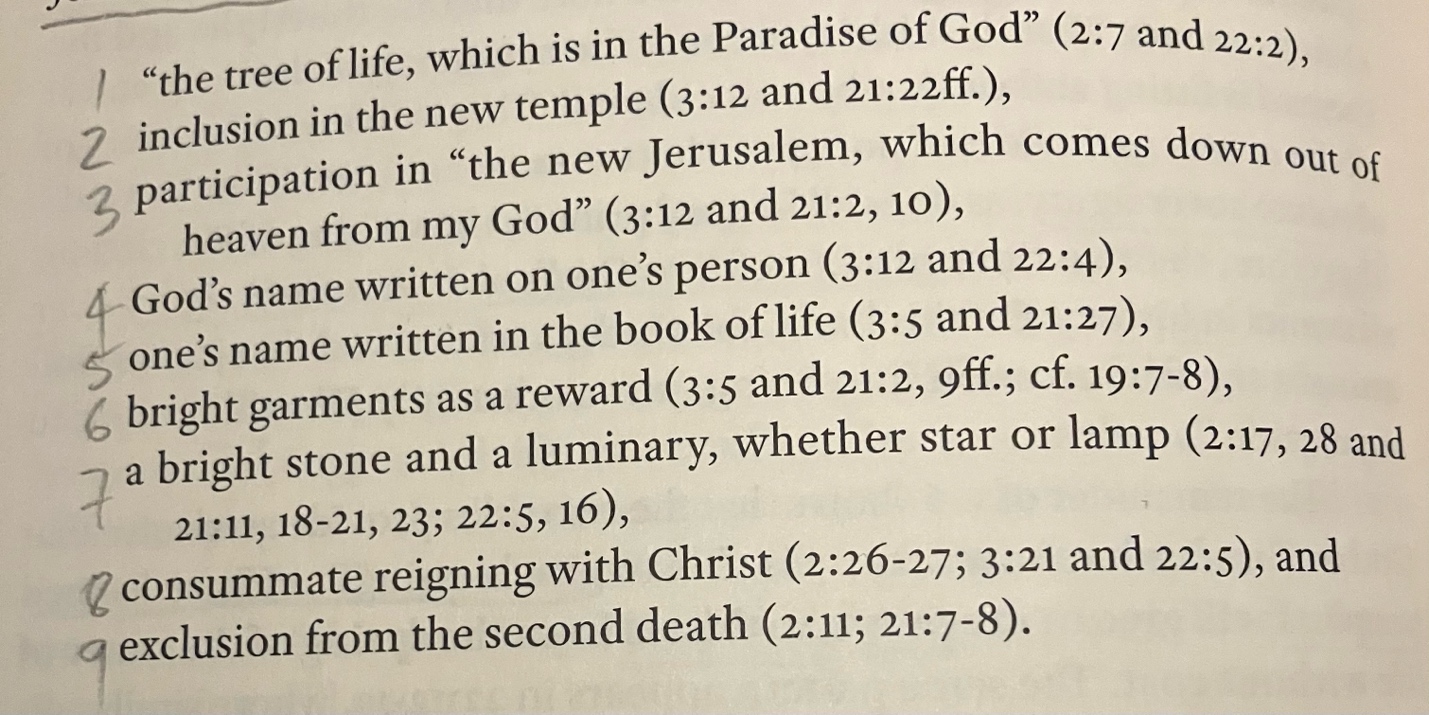
From: GK Beale – Revelation: A shorter Commentary
The condemned is named: fearful, cowards, unbelieving, sorcery (drugs), idolaters, fornicators (immorality), liars. We can never be arrogant and look down on these sins and sinners – this is written for the Church. They all have spiritual application as well. Immorality rules in worldly lifestyles, lying prevails for our own comfort, drugs are widely used to ease emotional and physical pain. It can easily get out of control and become idolatry.
Fear makes a person an unbelieving coward. John is speaking to the Church. It comprises a list of vices within the Christian community. There are those who turn their backs on a life of endurance. Cowardly suggest empty faith and it is followed by unbelief. (Matthew 8:26; Mark 4:40)
Abominable always suggests idolatry and although these vices are mainly pagan, some also occur in the Christian community. Harlotry and witchcraft are linked in 2 Kings 9:22.
The list concludes with all liars. This suggests the inclusion of false doctrine and compromising behaviour – from ethnic Jews claiming their exclusive access to God to those within the Church whose doctrine and life contradict their professed faith in Jesus. (1 John 2:4,22; 4:20; 5:10)
This list of sin condemns us all except that we find our righteousness in Christ. An almost identical list is to be found in the next chapter. (22:15) People who profess they know Christ while their deeds deny it. (Titus 1:16)
The lake of fire and brimstone is the second death. Evil cannot exist in the New Jerusalem.
9 One of the seven angels who had the seven bowls full of the seven last plagues came and said to me, “Come, I will show you the bride, the wife of the Lamb.” 10 And he carried me away in the Spirit to a mountain great and high, and showed me the Holy City, Jerusalem, coming down out of heaven from God. 11 It shone with the glory of God, and its brilliance was like that of a very precious jewel, like a jasper, clear as crystal. 12 It had a great, high wall with twelve gates, and with twelve angels at the gates. On the gates were written the names of the twelve tribes of Israel. 13 There were three gates on the east, three on the north, three on the south and three on the west. 14 The wall of the city had twelve foundations, and on them were the names of the twelve apostles of the Lamb.
Our inheritance is the city of God (21:9-27). This is our dwelling place. We dwell with God, in Christ. The city is based on the vision of Ezekiel 40-48 which prophesies of the latter-day Temple. (Latter day = after the advent of Jesus’ life, death and resurrection) It is clear that Ezekiel identifies city, temple and land as the same entity. The Bride is equated with the city, so it cannot be literal. (21:2,10)
The reference that the beloved city is under attack (20:9) suggests that the city portrayed in 21:9-22:5 is revealed in hidden, partial form throughout the church age as a result of Christ’s redemptive work. God provides the adornment of his Bride which reflects the glory of his creation. (1 Corinthians 3:5-15; 1 Peter 2:4-7)
The description of the Bride is symbolic just like the description of Babylon. Both are introduced with the Greek word deiknymi which means show, which refers to a symbolic matter.
The bride is shown by a surprise messenger – the bringer of the bowls of the plagues. The same angel, who acts as the bringer of the judgment of Babylon, now shows the Bride.
John is carried to a high mountain, just like in Ezekiel’s vision (40:2). He is raptured into the realm of the Spirit. (Ezekiel 43:5) The outlook from higher ground changes the perspective. We have to elevate ourselves above the circumstances. We are still earth-bound. We do not fly into the universe. We have to be removed from the ordinary in order to hear and see deeper and fuller. The elevation of the city of Jerusalem was well-known in OT prophecies. (Isaiah 2:2-3; 4:1-5; 25:6-26:2; Micha 4:1-2)
Beautiful in elevation, the joy of the whole earth,
Is Mount Zion on the sides of the north, the city of the great King. (Psalm 48:1,2)
Now it shall come to pass in the latter days that the mountain of the Lord’s house shall be established on the top of the mountains, and shall be exalted above the hills; and all nations shall flow to it. (Isaiah 2:2)
The Bride, the City, reflects the glory of God. It is thus not limited to a structure, but it is the people themselves who are the residence of God’s glory and his Presence. (Isaiah 58:8; 60:1-2, 19)
The light of God is like the radiance of jasper. God’s glory reflects in the precious stones. God’s glory is his awesome, tabernacling Presence with His people. The city and marriage pictures refer to an intimate communion with God. The brilliance is described as that of a star – Daniel 12:3 and Philippians 2:15. Christ is referred to as the Bright Morning Star. (22:16)
The precious stones are the saints – Philippians 2:15; Malachi 3:16-18
The city is walled, strong enough to protect against all evil.
In that day this song will be sung in the land of Judah:
“We have a strong city; God will appoint salvation for walls and bulwarks. (Isaiah 26:1).
He promises an insurmountable fortification, built by faith to guard the Church. Zechariah 2:5 talks about the wall of fire and His glory inside.
For I,’ says the Lord, ‘will be a wall of fire all around her, and I will be the glory in her midst.’ ”
The wall represents the inviolable nature of the city.
The twelve gates represent the tribes, through whom all gained entrance. An angel is stationed at each gate. The Messiah was born from the tribe of Judah as promised to give access for all. The word for gate is pulon (normally it would be pule.) Pulon could indicate two things. It could either be a large house built around a courtyard with big gate in the outer wall or the gate-tower of a walled city.
There is more than one entrance through the revelation of Jesus within the tribes. There are three gates in each direction. (Ezekiel 48:30-35)
East, where the sun rises depicts the morning of life when we find Christ young.
North is symbolic of cold for those who find Christ through intellect and cold rationalization.
South is symbolic of warmth. There is the gentle and soft way to find Christ through love and kindness.
West is symbolic of the setting sun and the dying. Even in the evening of their days, they will find Christ. We hear of so many deathbed conversions.
The twelve foundations depict the apostles who built the church. The tribes and the apostles incorporate the old and the new Testaments, both Covenants. (1 Chronicles 24:3-19; 26:17-19)
The apostles are the foundation and the tribes the gates – one might expect the opposite. The reversal highlights the fact that fulfillment of Israel’s promises has finally come in Christ, who together with the apostolic witness to the work of Jesus, forms the foundation of the new temple, the Church, which is the new Israel. (Ephesians 2:20-22)
15 The angel who talked with me had a measuring rod of gold to measure the city, its gates and its walls. 16 The city was laid out like a square, as long as it was wide. He measured the city with the rod and found it to be 12,000 stadia in length, and as wide and high as it is long. 17 The angel measured the wall using human measurement, and it was 144 cubits thick.
The measurements (21:15-17) remind us of the measuring rod of Ezekiel (40:3). It portrays the security of its inhabitants against the harm and contamination of the unclean and the deceptive. The measuring suggests God’s boundaries, and refers to the sealing of believers. (7:3)
In 11:2 the angels measure the temple which represents God’s dwelling place on earth. However, only the inner court is measured (the security of believers in the Presence) – the outer court is left unmeasured and thus open to attack. In this chapter the entire temple is measured, the city as a whole and God’s people are fully protected – spiritually as well as physically.
The shape of the city is a square. It is the perfect cube, a symbol of perfection in the Greek philosophy. (Ezekiel 45:2) The Jews were familiar with the shape of the altar of burnt offering, the altar of incense and the High Priest’s breastplate. (Exodus 27:1,30:2,28:16)
In Ezekiel’s temple and Solomon’s Temple the Holy of Holies was a perfect cube. (1 Kings 6:20) which indicates sufficiency, enough space for everyone.
The dwelling place of God has no exclusion. So must the Church be also. The angel measures the city according to Zechariah 2:2 where God give his assurance to be a wall of fire around her with his glory in her midst. (Zechariah 2:5)
The equal measurement of 12 thousand stadia reinforces the idea of completeness in the apostles and the tribes – 12X1000=12 000. The figurative nature of the city is confirmed in 21:16 where each of the four sides of the cubic city equals 12 000 stadia (Greek measurement for roughly 200 yards to one) , the sum of that is 144 000 to represent God’s people.
The enormous size of the City made it to be approximately the size of the then-known Hellenistic world – representing the redeemed throughout the world.
The symbolic meaning of the numbers, the wall and the description of the city is to explain the vision of heavenly truths in earthly terms.
18 The wall was made of jasper, and the city of pure gold, as pure as glass. 19 The foundations of the city walls were decorated with every kind of precious stone. The first foundation was jasper, the second sapphire, the third agate, the fourth emerald, 20 the fifth onyx, the sixth ruby, the seventh chrysolite, the eighth beryl, the ninth topaz, the tenth turquoise, the eleventh jacinth, and the twelfth amethyst. 21 The twelve gates were twelve pearls, each gate made of a single pearl. The great street of the city was of gold, as pure as transparent glass.
The gold of the city looks white in the sun, as if it is clear glass. Solomon’s temple was overlaid with gold (1 Kings 6:20-22) The clarity of the glass portrays divine glory and holiness.
The foundations were adorned with precious stones. It reminds of the precious stones in the breastplate of the High Priest representing the tribes. The jewels of the breastplate is transferred to the foundation stones of the New Jerusalem, a reference to the Holy of Holies. See also 1 Kings 5:17; 7:9-10 on the precious stones in the temple of Solomon. (Isaiah 54:11-12)
Jasper is a translucent green, sapphire is mentioned in Exodus 24:10 on which God stood, sky-blue flecked with gold more like lapis lazuli, Chalcedony looked like silicate of copper, sort of green as a dove’s neck or a peacock’s tail.
Emerald is well known, the greenest of all green stones. Sardonyx looked like onyx with layers of red and brown and used for cameos. Sardius (like a ruby) originated from Sardis and was blood-red. Chrysolite is of uncertain origin and was shiny like gold according to Pliny. Beryl was sea-blue or sea-green in colour and topaz was a transparent greenish-gold (Job 28:19).
Jacinth was a deep violet-colour, bluish-purple and the amethyst was purple. Eight of these stones mentioned were in the breastplate of the High Priest (Exodus 28:17).
The splendour of the city was much more than the known stones.
Originally, the city of the Greek gods was built according to the signs of the Zodiac and every sign had its stone. They were exactly these twelve stones. No other city with precious stones existed. John replaced the city of the gods to wipe out all confusion. With this description he included all the beliefs about all precious stones to show one God over all.
John gives the signs of the Zodiac in reverse order, to submit them all under the authority of God.
It is staggering to imagine each gate is one big pearl. Pearls were especially valuable. They were taken from the sea at great peril.
Pearls are made when a mollusk, like an oyster, coats an irritant with layers of a substance called nacre to protect itself. In natural pearls, this irritant is often a parasite or a piece of sand that gets inside, deep into the “heart” of the shell.
The parable confirmed this when Jesus talked about the pearl of great price, worth everything you possessed in Matthew 13:46. Gates of pearl depict unimaginable and inaccessible wealth.
The “gate” to the true Church, the New Jerusalem, which is the Presence of God, is the “irritants” of our lives that form our testimony. God “forms” our most precious jewel deep in our heart and upon the beauty within we enter.
The streets of the city were pure gold, like transparent glass. Pure and transparent indicate the ability to reflect. The streets of the City reflect the glory of God in our testimonies – hardship and reward, answer to prayer. (3:18 the counsel of the heavenly Merchant)
Golden streets also refer to the slaying of the two witnesses (11) where they are resurrected and glorified as effective witnesses. The inglorious path of the Church is now transformed into a dazzlingly, glorious one in the new city.
I did not see a temple in the city, because the Lord God Almighty and the Lamb are its temple. 23 The city does not need the sun or the moon to shine on it, for the glory of God gives it light, and the Lamb is its lamp. 24 The nations will walk by its light, and the kings of the earth will bring their splendor into it. 25 On no day will its gates ever be shut, for there will be no night there. 26 The glory and honor of the nations will be brought into it. 27 Nothing impure will ever enter it, nor will anyone who does what is shameful or deceitful, but only those whose names are written in the Lamb’s book of life.
God is present in this great city. (21:22-23). It is a city with no temple. It is surprising. To the Jews, the Temple was everything. Now there is no need for the temple. God is everywhere. The city is in its entirety the Holy of Holies. The Ezekiel-described Temple (40-43) is now summarized into one phrase: the Lord God, the Almighty and the Lamb are its temple.
“Then it shall come to pass, when you are multiplied and increased in the land in those days,” says the Lord, “that they will say no more, ‘The ark of the covenant of the Lord.’ It shall not come to mind, nor shall they remember it, nor shall they visit it, nor shall it be made anymore.
17 “At that time Jerusalem shall be called The Throne of the Lord, and all the nations shall be gathered to it, to the name of the Lord, to Jerusalem. No more shall they follow the dictates of their evil hearts. (Jeremiah 3:16-17)
The glory of this latter temple shall be greater than the former,’ says the Lord of hosts. ‘And in this place I will give peace,’ says the Lord of hosts.” (Haggai 2:9)
“For behold, I create new heavens and a new earth;
And the former shall not be remembered or come to mind.
18 But be glad and rejoice forever in what I create;
For behold, I create Jerusalem as a rejoicing,
And her people a joy. “For behold, I create new heavens and a new earth;
And the former shall not be remembered or come to mind.
18 But be glad and rejoice forever in what I create;
For behold, I create Jerusalem as a rejoicing,
And her people a joy. (Isaiah 65:17-25)
This replacement of the Temple was inaugurated by Christ’s own words when He referred to his own Resurrection as the rebuilding of the Temple (John 2:19-22; Mark 14:58; 15:29)
In Matthew 21:42 Christ is referred to as the chief cornerstone. (Mark 12:10-11; Luke 20:17-18; Acts 4:11) In Ephesians 2:20 Christ is the chief cornerstone of the Church. Alos in Revelation 1:12-20 in the description of the risen Jesus amongst the Lampstands. In Revelation 11:1-2 the reference to the sanctuary identifies the people of God already members of God’s temple in heaven even though still living on earth. The end-time heavenly Temple protects believers during their sojourn on earth.
This break with a non-architectural temple is an important break with Judaism which consistently affirmed the hope of a final, material temple on a larger scale than ever before.
God will be your everlasting light says Isaiah 60:19-20. In Your light we see light (Psalm 36:9) In the light of God we truly see.
But… in this city there is no night and no need for light. In the light of God there is no darkness possible. The ancient people were afraid of the dark. (Exodus 22) God’s light drives out fear. God’s glory is infinitely more than any earthly light-giving sources. (Isaiah 60:19)
God’s presence satisfies every need. (Ezekiel 43:2,50) In these verses Isaiah 60 is confirmed in every detail: 60:2,5 = 21:24; 60:11 = 21:25,26.
The kings of the earth will bring their glory into it – gold, frankincense but also the good news of the praises of the Lord. Isaiah 66:12 – the glory of the nations coming to Israel. They are not bringing literal riches but themselves as worshippers – praise directed to God and the Lamb.
The righteous acts of the redeemed are the jewels that reflect and represent the glory of God. The nations have broken off their idolatrous relations with the beast and acknowledge that all honour and glory on earth belong to God.
The gates shall never be closed and there shall be no more night there suggest unhindered access to God in the light of guidance not in the darkness of confusion. The believing Gentiles will never be separated from open, eternal access to the living God and nothing evil can ever threaten that access. The gates of the old Jerusalem had to be closed at night.
The angelic beings blocking access to the Garden of Eden (Genesis 3:24) have now been removed to give access through the Lamb to all the splendour of the glory of God. (22:14)
The newness is emphasized by the promise of no more night (21:25 and 22:5 stands in bright contrast to Genesis 8:22. (Night and day shall not cease while the earth remains.)
Space for all nations is a theme throughout the writings of the prophets. (Isaiah 2:2-4, 11:12, 45:22, 49:6, 51:5, 55:5, 56:6-8, 66:19. Jeremiah 3:17, 16:19-21. Daniel 7:14. Zephaniah 2:11, 3:9. Zechariah 2:13, 8:20-23, 14:9. Also in Joel 2)
The nations in Revelations are twice seen as composing the company of the redeemed (5:9; 7:9) They are identified as those purchased from every tribe, tongue, people and nation.
In the Jewish writings between our two Testaments, the theme of the Messiah gathering all nations was prominent. John paints the picture of divine hope for the Jews as well as the Gentiles.
The nations will bring gifts. The Greeks will bring their philosophy in which they were constantly seeking God. The Romans bring administration, law and organization and the Hebrews brought the true God and the Messiah. We bring our gifts and talents to the church.
Those not submitted to God cannot enter – nothing unclean and no one who practices the abomination and lying shall ever come into it. Also those that made a profession of faith but contradict it with their sinful lives and lifestyles – they are liars.
Only those who are given access by the Lamb’s Book of Life can enter. Abominations and lies are caused by the rejection of Jesus. God is insulted when Jesus is rejected. Jesus is His gift, His best to us.
The Lamb’s Book of Life are mentioned elsewhere. (3:5;13:8;17:8:20:12,15)
And it shall come to pass that he who is left in Zion and remains in Jerusalem will be called holy—everyone who is recorded among the living in Jerusalem. (Isaiah 4:3)
The Book is the security for those in the Holy City. They are protected from the deceptions of this world.
John warns the churches at the time to rethink the final outcome of their choices. The refinement of God’s people is the goal of the whole book of Revelation. It is making clear where deception will lead and where the glorious choice to “follow the Lamb wherever He goes” will lead.
Here is the link to the podcast on Spotify:
 Pebbles of Perpetuity